
Baldwin County Previous-Resident Sources
The best source depends on the period and the question. Current appraisal data identifies the parcel and present tax owner. Recorded deeds establish transfers, but do not establish who slept in the building. Tax books add annual continuity. A census or directory can supply occupants, while permits and maps date physical change. Baldwin County previous-residents research is most reliable when ownership and household evidence meet at the same parcel and year.
| Source | Verified years | Where held | What it shows |
|---|---|---|---|
| Online deeds and mortgages | 1899 to present | Probate Recording Division | Recorded parties, dates, instrument and legal description |
| Archived deeds, liens and mortgages | 1804 to 1954 | County Archives | Pre-web ownership and encumbrance trail |
| Land and tax records | Land 1890 to 1950; tax 1890 to 1979 | County Archives | Parcel and taxpayer continuity |
| Plats and lot books | Plats 1830 to 1979; lots 1919 to 1979 | County Archives | Subdivision, lot, block and road context |
| County newspapers | 1890 to 2012 | County Archives | Obituaries, sales, moves and social notices |
| Federal census | Public through 1950 | NARA and research access | Enumerated households under the 72-year rule |
| County permits | Split at November 1, 2020 | Building Department and Open Baldwin | Work, dates, site and project parties |
| Sanborn maps | Bay Minette 1927; Foley 1946; Robertsdale 1947 | Library of Congress | Building footprint, use and address context |
Begin with a current parcel even when the target period is old. Its parcel number, subdivision, lot, block, and legal description form the crosswalk into earlier records. Then choose the dated source nearest the year of interest rather than assuming an unverified directory run exists.
Trace Baldwin County Previous Residents
The Revenue Commissioner Property Search supplies the current anchor. Save the owner, situs and mailing addresses, parcel number, legal description, and any deed citation. Situs is the property's physical address. The mailing address is merely where the owner receives the tax notice. That distinction prevents an absentee owner's mail destination from being mistaken for a former household.
- Resolve the current parcel in Property Search or the county map viewer. Copy its full legal description and deed reference.
- Open the current purchase instrument through Probate Deeds and Records. Record the grantee, grantor, execution and recording dates, instrument number, and land description.
- Search the seller as a grantee in an earlier transaction. Accept a candidate only when the land description matches.
- Repeat the process until the online index reaches its 1899 threshold. Use book and page or instrument numbers whenever available.
- Continue at Probate public stations or through County Archives for earlier deeds, tax books, plats, and related land files.
The role names repeat at each transfer, so the matched land description matters more than a familiar surname alone.
- Grantor and grantee
- The grantor transfers an interest; the grantee receives it.
- Chain of title
- The linked sequence of recorded transfers for the same property.
- Legal description
- The formal lot, block, subdivision, or boundary wording that identifies land even when a street address changes.
- Recording date
- The day the instrument entered the public record, which can differ from its execution date.
Baldwin County Previous Residents Before 1899
The year 1899 is a portal boundary, not the birth of the Baldwin County land record. Probate's online deeds and mortgages begin with Book 1 in that year. The Baldwin County Department of Archives and History preserves deed, lien, and mortgage material from 1804 through 1954. The overlap from 1899 through 1954 lets a researcher compare an online index or image with archival material before moving fully into the older series.
Baldwin County was created in 1809, yet the Archives holds deed-related material starting in 1804. That five-year reach is a useful local story and a warning. Early geography did not match today's county map. The 1810 and 1816 lists reflect territorial conditions, and one reproduced 1810 census notes that the old Baldwin area then lay west of the Tombigbee, with records held in Mississippi. Names from that era require geographic proof.
Note: No official source documented a Baldwin courthouse fire that erased a defined record series, so generic fire-loss claims should not shape the search.
Baldwin County Previous Residents by Parcel
Tax books can fill the gaps between deeds. Baldwin County Archives holds them from 1890 through 1979, creating a year-by-year taxpayer trail that can show continuity or a change between recorded transfers. Land records cover 1890 through 1950. Plats from 1830 through 1979 and lot books from 1919 through 1979 stabilize the site when the modern house number did not yet exist.
Record four coordinates for every match: person name, parcel or legal description, year, and community. Those points reduce errors caused by repeated surnames and changing place names. A plat can show where a subdivision lot sat, but it does not name the household. Likewise, a tax book identifies the taxpayer tied to the land for that year, not each occupant. Pair either source with a census, newspaper, or directory before calling a named person a resident.
Note: Tax-book continuity supports a timeline, but it does not show every person who occupied the Baldwin County property.
Date Baldwin County Past Residents
Physical records help determine whether the same structure existed during a claimed residence. Library of Congress Baldwin-area documentation connects to compact Sanborn fire-insurance map sets for Bay Minette in 1927, Foley in 1946, and Robertsdale in 1947. Use the title or index sheet, locate the block, and note the footprint and use. A Sanborn map documents the built setting, not the occupant.
For later work, Open Baldwin splits county permits into reports before November 1, 2020 and a newer permit or inspection route after that date. Search both if a project could cross the cutover. Permits can name an applicant, contractor, site, work type, issue date, and status. Inside city limits, the applicable municipal building office may hold the file instead.
A demolished structure, a renumbered road, or a new 911 assignment can break an address-only search. No countywide renumbering year was verified. Use parcel number and legal description as the stable bridge, then ask county 911 GIS or the proper municipal office to verify the present address.
Match Baldwin County Past Residents
Owners are only half the answer to who lived here before. A city or telephone directory may name a selected subscriber or householder. The public federal census can show the enumerated household through 1950 under the 72-year rule. Baldwin newspapers add obituaries, social news, sale notices, and business ties. These sources can reveal people who never appear as deed grantees.
- Start with a known address, parcel, and year range from the ownership trail.
- Check the closest verified directory or telephone listing. Copy the entry exactly, including spelling, locality, abbreviations, and telephone details.
- Pair that snapshot with the nearest public census and confirm the correct community or enumeration area.
- Search the county newspaper run for the name, address, relatives, moves, or death notices.
- Return to deeds and tax books to decide whether the person was an owner, an occupant, or both.
The verified statewide catalog has a Mobile-Baldwin directory for 1997, but no long annual local run was established. Telephone-directory entries for Bay Minette and Fairhope also exist in digitized national holdings. The Baldwin County city directory page treats those collections in depth. A disappearance between editions is only a clue because canvass dates, omissions, and rural coverage vary.
Verify Baldwin County Previous Residents
An obituary or probate file can close a trail when a past resident died or the property passed through an estate. The Archives newspaper collection runs from 1890 through 2012 and includes the Baldwin Times, Fairhope Courier, Onlooker, Islander, Eastern Shore Courier, Independent Courier, and Bulletin. Its American Banner CD covers September 1899 through February 1902 and preserves names and events from Baldwin's Black community that may be thin in broader indexes.
Baldwin Probate iQuery allows queries of cases marked public and may show events, citations, charges, and docket or court notes. For an estate, inspect public petitions and notices for heirs or interested parties, then follow any recorded estate deed back to the same legal description. Adoption and other confidential matters are excluded. An obituary is rich narrative evidence, while a probate filing or recorded deed gives a more formal link. Use them together.
Baldwin County Previous-Resident Research
The County Archives research service is the strongest official remote fallback for a Baldwin County previous-residents project. Its collections bring deeds, plats, lot and tax books, maps, photos, newspapers, census materials, and court files into one request path. Staff provide up to 30 minutes of research at no charge. Longer work costs $15 for a Baldwin resident or $25 for a nonresident, includes up to 20 photocopies, and additional pages cost 25 cents.
The posted response window is 24 to 72 business hours after receipt. The fee remains nonrefundable if no match appears, but the service sends a report and suggestions for further work. A focused request should state all name variants, the exact present address, parcel and legal description, the community, and a bounded year range. Researchers may also use the Archives and microfilm rooms. Research hours are Monday through Thursday, 9:00 a.m. to 3:00 p.m.; call before a visit because staff may be working away from the facility.
Note: Archives is a bridge for evidence, not a promise that a named reverse-directory edition or every former occupant survives.
Federal Clues to Baldwin County Residents
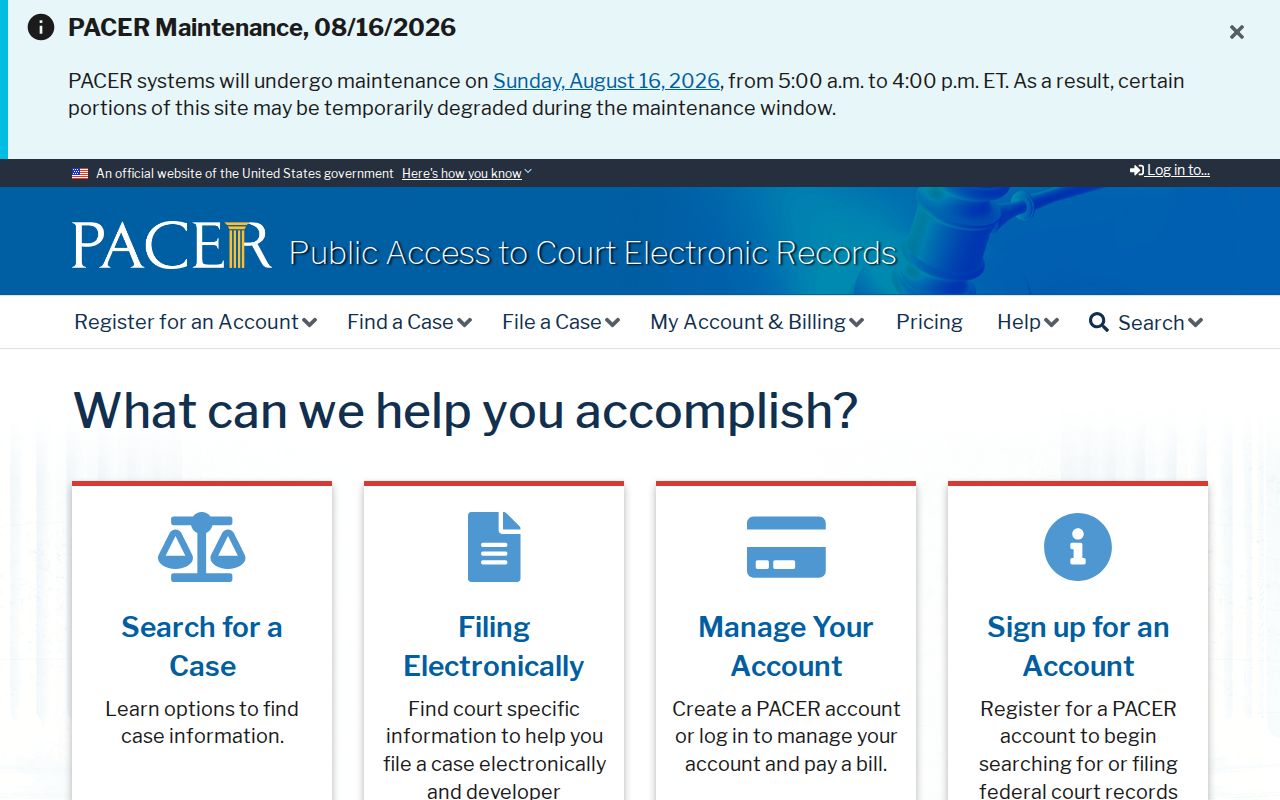
A federal case is an occasional endpoint, not a core house-history source. Baldwin County lies in the U.S. District Court for the Southern District of Alabama. If a newspaper, deed, estate file, or other dated source cites a federal matter, PACER can search federal case records by account. Its published access costs 10 cents per page, generally capped at $3 per document, with the current quarterly fee-waiver threshold set by PACER policy.
The assigned Baldwin County previous-residents capture shows the official federal records gateway.
Use a case result only to verify the named party, court, date, and public filing. It does not prove that an address in a pleading remained the person's home.
Bridge Baldwin County Past-Resident Addresses
A road name or house number can change while the land remains the same. Baldwin County 911 GIS & Addressing creates and verifies addresses outside municipal limits; city planning or addressing staff handle sites within city limits. A USPS city label may cross those lines. For past residents, first prove that the old and new labels point to the same legal parcel rather than matching them by sound alone.
Use a plat to fix the subdivision, lot, and block. Compare that wording with deeds and tax books. Where available, add a Sanborn index sheet, permit, newspaper address, or census location. In Fairhope, the Fairhope Single Tax Corporation's PastPerfect archive can add leaseholder, photo, and community evidence where a simple fee-owner model would miss part of the story.
Note: Match old and new address labels through the parcel and legal description before treating them as the same Baldwin County site.
Use Baldwin History Lawfully
Previous residents research works best as house history, genealogy, estate work, or a way to understand community change. Keep citations and dates with every name. A deed proves a legal transaction, a parcel card links the assessed owner to land, a permit ties a person to work, and a directory gives a publisher's snapshot. None alone proves a complete household or a present address.
Stop when an address is protected, a record is sealed, or two people with the same name cannot be separated. Alabama's Address Confidentiality Program and other record-specific protections exist for safety. Public availability does not allow repeated unwanted contact or efforts to defeat a substitute address.
Lawful use. Baldwin County previous-resident records may support family and property history. Never use them to stalk, harass, threaten, or track a living person.